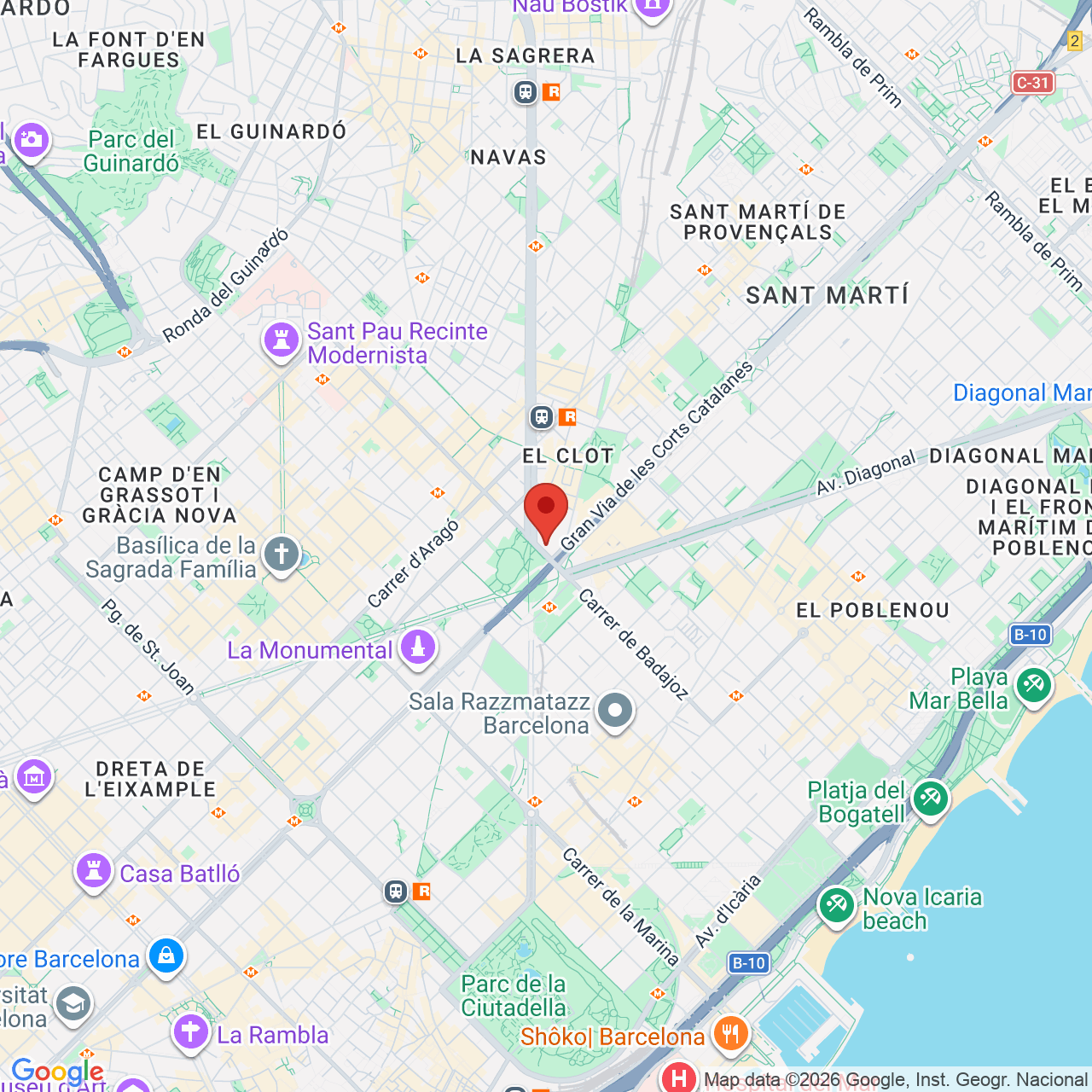
Barcelona City


Barcelona City is not for the faint of heart. It is crowded with Spanish tourists in the main sightseeing areas like Sagrada Familia or Park Guell, and there are pickpockets creeping up behind you as you walk the Gothic quarter. Usually when you explore big European cities, you can find a leafy square, have a cup of tea, and catch your breath. But in Barcelona there really aren't any nice places to do this. The squares have a pungent sewer smell, and in April, balls of Plane tree pollen are strewn everywhere, making your nose stream down. Occasionally you can find a classy bakery and have a rest, but these are rare.
If you love architecture, you will want to see the Catalan Modernist sites in Barcelona. You will experience great highs, while seeing the architecture, and great lows, while trying to provide your needs for the rest of the day, while in Barcelona.
One way to find some rest between architecture sites is to sit on the stairs at the MNAC. Here you are at a higher elevation in the city, so the sewer smells are not as bad. You are still in a tourist trap, with peddlers clacking castanets, and people buzzing all around you. But you have an impressive view with huge sculptures over the city with in front of you, the sun to calm you on the steps, and usually some good music being played by a busker. Have your hand over your purse or wallet and enjoy. After, you can walk peacefully around the fine art museum, MNAC (closed Mondays), enjoying some wonderful art nouveau and late 19th century art in the Modern Art section. Usually modern art is ridiculous works from the 20th century, but here it includes late 19th century art. The gardens, such as the Jardin Historico, are leafy, not concrete (like many other parks and gardens in Barcelona), but there are some sketchy types in their spooky corners. You can walk around by the Olympic stadium and museum along tree-lined paths with a few more people, to enjoy a peaceful, safer stroll. Here you won't be dodging motorcycles and cars as much as in the city center. The MNAC is a peaceful place to eat. It has a coffee stand at the top of the stairs with seating, a self-serve cafeteria with pastries in the magnificent Oval Room (inner courtyard of the museum with the organ), museum cafe called Oval Cafe with no windows next to the cafeteria, and fancy restaurant called Restaurante Absis with stunning views of the city. We only ate in the Oval Cafe, which does not have good food, nor atmosphere/service.
Another peaceful place without sewer smells (because of its high elevation) is Tibidabo. Not many people come here since it's a longer taxi ride from the center of town. The wealthy people live up here in the foothills. They drive up in teslas to dine at cafes with views over the whole city. We didn't eat at any of these but I think they would be a restful place to eat with wonderful views! Arrive at the Tibidabo Funicular. This is where the cafes are. Then you can catch the modern, excellent funicular up to the top. Here you will find an overpriced antique amusement park (39 euros to enter) with carousel and cute rides. Too bad it's so expensive! You can go inside Temple of the Sacred Heart of Jesus. There are two churches to this, the first, at the base, which is beautiful and special, and the second, up a windy flight of stairs (take the right side for less wind) to a very plain oversized church with not enough windows to let in light. Make sure you spend some time in the lower church. It has seafaring-themed stained glass and sculptures that are delightful. Joy! The lookouts over the city, the wooded hills, and ocean are nice too. The drive up is also enjoyable, past castle-like mansions. Tibidabo has cold, windy, overcast weather often, but it's still worth it to go! Bring a puffer jacket.
Now that you have some peaceful and less stinky spots to go after your flight, you can tackle the Catalan Modernist architecture spots with alert strength. The two most incredible ones that you don't want to miss are Sagrada Familia (Gaudi's cathedral) and Palau de la Musica Catalana (Domenech i Montaner's concert hall). Domenech i Montaner was a professor who taught Gaudi, though he was only two years older than Gaudi. Catalan Modernist architecture, Spain's version of Art Nouveau architecture, was a rebellion against the overly formal, repetitive architecture of the past, that kept imitating Gothic, Renaissance, and Baroque styles. It wanted something fresh and new. It introduced rounded shapes, curvilinear forms, nature-inspired motifs, fantastical themes, and dynamic geometric lines, bright whimsical colors, and plenty of airy light. Just walking into Sagrada Familia will awe you so much that you want to cry. Somehow you feel love all around you. Skip climbing the tower, as it's claustrophobic and makes you dizzy.
The indoor details of Palau de la Musica Catalana are just some of the most beautiful things you'll ever see. Don't miss the balcony with tiled columns too. There is a wonderful indoor cafe, outdoor courtyard with stairs to sit on, and gift shop- the best you'll ever find- in Palau de la Musica Catalana. After visiting Palau de la Musica Catalana, you can walk the Gothic quarter, but keep your hand on your purse or wallet as pickpockets will keep appearing behind you. A nine minute walk south is the Picasso Museum, set in a medieval mansion. It's always nice to visit a cozy one-artist museum, and this one has his earlier more-accessible Cubist works, plus simpler works such as birds by the seaside. I visited years ago so I can't give any recent advice.
Another site that showcases Domenech i Montaner architectural genius is Recinte Modernista de Sant Pau. Its colorful tiled rooftops are gorgeous, and its administration building has the most incredible pink interior (photo above). It is a short, safe walk up Avenue de Gaudi from Sagrada Familia, so you can combine the two. Its "garden" is just a huge expanse of concrete, but in late April the orange blossoms smell amazing and look adorable. Because this was a hospital, there is a bit of a gloomy, depressing feel to a visit. And the cement makes the view across the garden/courtyard washed out. It probably looks prettier to look out across the courtyard to the tiled rooftops very early in the morning or at sunset, when the white cement isn't ruining the light. Come at those times if you can! Otherwise, if you don't have time, this is not an essential stop. One good thing about it though is that it is quiet and uncrowded.
Another stop that is both good and bad is Park Guell, built by Gaudi as a housing development planned to have sixty luxury homes, but which failed due to it having no tram connection to the city and was turned into a public park in 1926. Gaudi House, in the park, was the model or show home for the development. It was not built by Gaudi but he lived in it before Park Guell became a public park. It is now a sparse museum showing Gaudi's furniture design. Another of the mansions built before the residential community failed, in 18th century rural Catalan style, is Casa Trias, which is now a private home at the top of the park that you can walk by. Park Guell consists of several unique sites. There are the gingerbread-style houses that were the residential development's whimsical gatehouses designed to attract interest from buyers. The highly-photographed Nature Square is a large, packed-dirt terrace with canary palms, imaginative mosaic tiled serpentine benches (the plaza was going to host shows for the residents of the development), and views over the city. The Hypostyle Room (do not miss it!!!), below the Nature Plaza, is an incredible spot where you can get lost in its magic (it is less crowded). Here 86 absolutely gigantic columns stretch up to a ceiling of curved mosaics symbolizing the four seasons and lunar cycles. The design at the top of the columns is just gorgeous. This area is like nowhere you've ever been! It was supposed to be a marketplace for the residents. Similar to the Hypostyle Room but smaller and less fancy is the Portico of the Washerwoman (inside is a statue of a laundry maid), an area of stone columns set against the hillside in the shape of a wave- don't miss this either! The rest of the park has walkways over rock viaducts with small circular benches between them. I don't know what to think of Park Guell. It's too crowded to enjoy it. But you have to see the Hypostyle Room! Maybe if you come first thing in the morning at 9am (google maps lists this as the least busy time) on a cold day? Definitely 3pm on a weekday in April was not a good time to come. The Gracia neighborhood is not a nice place to walk around after (sewer smells, crowds, cars, unpleasant cafes), despite recommendations to the contrary. So, see the Hypostyle Room and then hightail it out of there! One good thing is that Park Guell is up on a hill so you don't get sewer smells. Buy tickets well ahead of time because this park sells out.
Casa Batllo is another Gaudi creation, a mansion he renovated, located in the ritzy Eixample neighborhood. It is far too crowded to enjoy the tour in such a cramped house with narrow rooms and passageways. The designs are strange and curvilinear. Only visit if you can go at 8:30am or 9:30pm, the least busy times according to google maps. If you do visit Casa Batllo, you can have a melted chocolate treat, ham croissant, or fruit smoothie (or all three!), at Casa Amattler next door, which you buy at their cramped counter-service cafe called Faborit and eat in the tiny back courtyard or side room under hanging vintage lightbulbs. We met a nice Erasmus student from Mexico City there. Admire the stained glass and ornate Moorish details of Casa Amattler, designed by Catalan Modernist architect Josep Puig i Cadafalch, who studied 13 years after Gaudi. After, stroll the fanciest street, Passeig de Gracia, with its Modernist streetlamps, in the wealthy neighborhood of Eixample. Walk past rich Catalan Modernist rowhouses, such as Casa Batllo, built around the turn of the century. This is a street of high-end stores swarming with tourists, but with prettier architecture than your typical grubby Barcelona street.
El Poblenou is a modern, revitalized neighborhood on the eastern outskirts of the city where locals go to eat. They stroll the Rambla del Poblenou, a good alternative to the touristy La Rambla. Joggers take the Rambla del Poblenou all the way to Bogatell Beach, which looks like Venice Beach in California. This sounds idyllic, but there are sewer smells that will literally knock you over. If you can handle it though, the restaurants here are good. El Fornet is a classy (but unfriendly) bakery with gold decor and big windows. Two restaurants with the same owner, La Tavernicola and Alma Loca, have excellent food you will remember! Try the sweet potato fries with lime and parmesan at Alma Loca, which has a youthful, friendly atmosphere, much friendlier than most cafes in Barcelona. Es Bien Coffee, bordering the Glories Mall, has the best matcha tea in Barcelona. The Plane tree pollen in these tree-lined streets is beyond awful in April- don't come if you have tree allergies!
Parc de la Ciutadella and its gateway Arc de Triomf, built for the 1888 Barcelona World Fair, is beautiful but a bit rundown and full of crime. It has outdoor salsa dancing by the fountain on Sunday afternoons. We didn't visit this area.
To escape the city, take the Moventis bus from Bus Station Nord to Lloret de Mar on the Costa Brava! It only takes one hour to be in paradise. Don't take the R1 commuter train- it is like the worst shaky theme park ride but lasting an hour.
One piece of false information online is that people speak Catalan, and rarely Spanish, in Barcelona. We found that everyone was speaking Spanish, except a few people in the outer suburbs when speaking quietly among themselves. At cafes and in markets, people speak Spanish to you when serving you. So you only need to learn Spanish, not Catalan, in order to get treated with a better attitude in Barcelona. Some signs are in Catalan, but speaking Catalan is not necessary. One phrase that will get you by in most situations is "Quisiera...., por favor" or "I would like..., please" such as when ordering a coffee or water. It is easily remembered and pronounced by thinking "Key Sierra" in your English-speaking mind!
Few people speak English in Spain, as TV shows are dubbed not subtitled, and public schools hire Spanish speakers, rather than native-English speakers, to teach English grammar and vocabulary, not conversation. People who attended private schools as children are more likely to be able to speak English. Generally people tend to be less friendly when they know they don't speak English well, because they are apprehensive as you approach them. People in the tech industry speak better English than people in government, for example, which might explain the lack of friendliness you encounter when dealing with government ticket offices.
Barcelona is located on the Mediterannean sea, in the northeast corner of Spain!
Last Updated: Thu, 13 Aug 2026 17:12:24 GMT
Text and Image copyright: © 2006-2025 LotsaFunMaps.com.
Copying prohibited. Contact the editor |
Facebook |
Pinterest |
Instagram
Blog |
The Official Mug |
Privacy Settings |
About Us